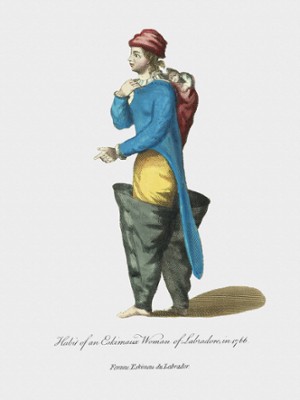
The above engraving, created by Thomas Jefferys in 1766, offers an interesting, if somewhat stylized, depiction of the native population that inhabited the coast of Labrador in the mid-eighteenth century from a European perspective.Caught at a moment of stately poise, the above engraving captures the image of a woman from Labrador in her typical costume. The most important item of clothing in this scene is the amauti, an ingenious item of apparel, which functions not just as protection against the cold but also as attire for nursing mothers. The large hood and tail or flap are indicative of the way the culture adapted itself to the challenging sub-arctic environment.Rather than creating a vague image of "savages," Jefferys' engraving tries to capture more ethnographic details such as the sewing technique of the garment made of seal or caribou skin as well as kamiks, waterproof boots vital for negotiating the ice.