
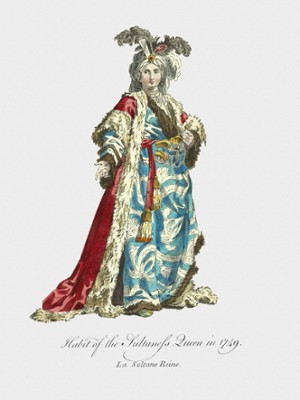
There are very few engravings of costumes from the 18th century which can be as interesting as the one depicting "Habit of the Sultaness Queen" by Thomas Jefferys. Created in 1749, the engraving forms a part of Thomas Jefferys' famous collection of "A Collection of the Dresses of Different Nations".Apart from representing an interesting period in the history of costume study, the engraving represents the Western obsession with all things Ottoman. More specifically, this particular engraving depicts the "Sultaness" (also known as Haseki Sultan) resting royally.The main characteristic features of the engraving include the depiction of several layers of caftan, the ornate embroidery of şalvar (Ottoman trousers) and the richly jeweled and feathered hotoz. In contrast to the previous depictions that often depicted costumes as stiff and motionless objects, Jefferys' 1749 engraving shows the luxurious materials in motion through soft lines and depicts brocades and silks of the mid-18th century.